
Oakdale Cemetery Tour
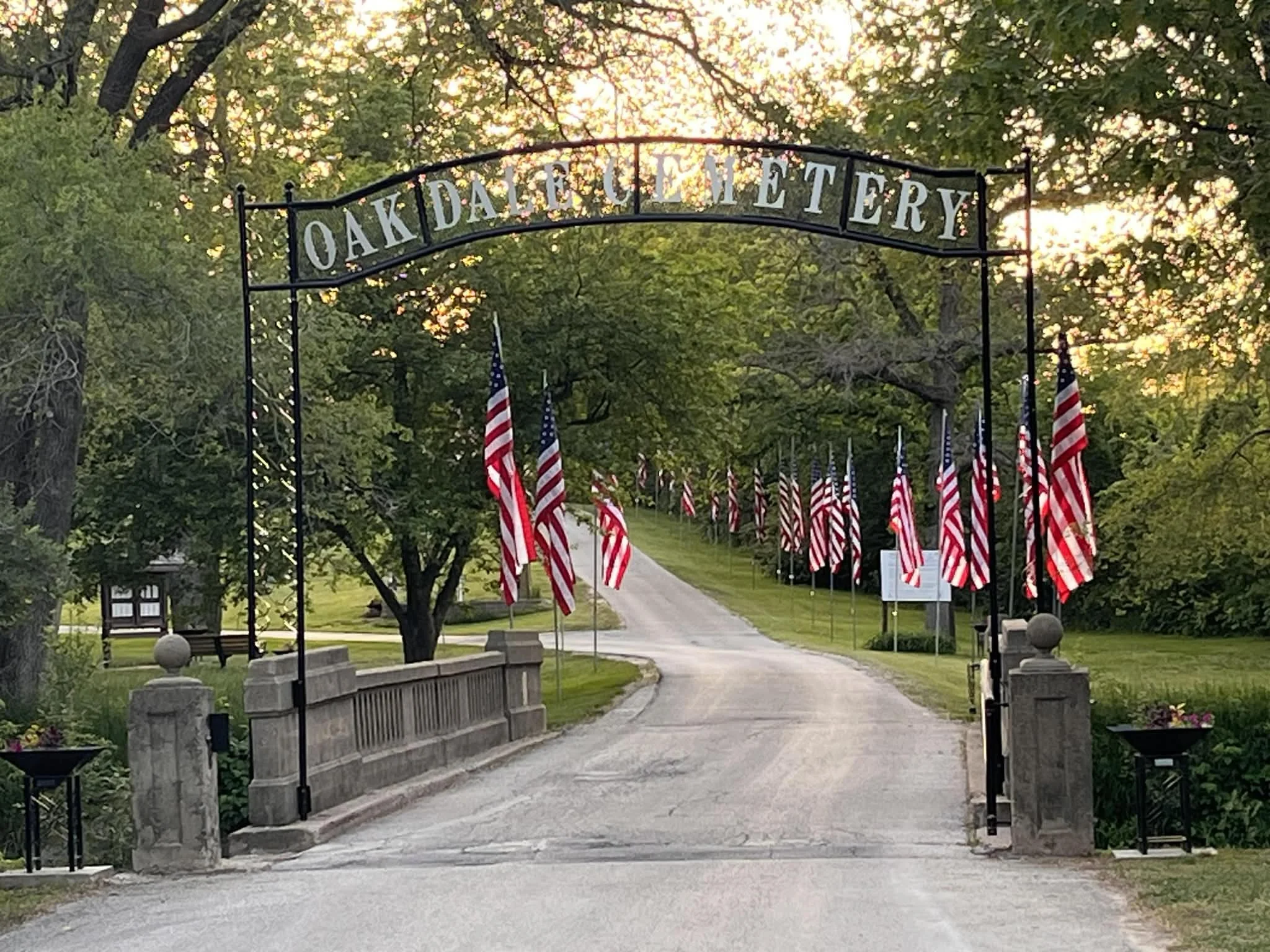
Steve Straight, David Sande, and Nanci Sande developed a tour of Adel’s Oakdale Cemetery for Adel’s 175th anniversary in 2022. They graciously gave permission for us to publish it on the website. Steve conducted the research for the tour and David and Nanci narrate the live tours. Follow us on Facebook to hear about the next in person cemetery tour! The tour gives gives us an awareness of the rich history of Adel while pointing out the grave sites of some of Adel’s founding fathers and other distinguished citizens of Adel’s early days.
Virtual Tour:
Please join us virtually on the cemetery tour by reading the information below. We will visit the final resting places of Adel’s early pioneers whose hopes, dreams, and aspirations helped develop Adel into the growing community it is today. The names are listed in order given during the tour (not alphabetically).
Before we begin the tour, let’s go through some history on Adel’s historical cemeteries.
The first burial ground was a mile south of Adel. This cemetery was used for some time, but it was not in a very satisfactory location.
Consequently, the Rodenbough or Van Fossen cemetery was established 1 miles west of town. This location was also abandoned after a few years.
The current Oakdale Cemetery was established along the Raccoon River as the new cemetery site.
1. Don A.Blanchard
In 1866, Don Blanchard was intending to visit Omaha, but he accidentally stopped over on Sunday in Adel. After looking over the location, he was impressed with its natural beauty and business possibilities.
For a long time, he kept expanding his hardware business until he was pretty much controlling it in this area of the country. When Adel was left without any railroad facilities, he was one of the first to help save the county seat in Adel. He was also one of the largest contributors in time and money to the building of an independent railroad to Adel.
When the present courthouse was built, the citizens of Adel presented the courthouse clock as a gift to the county, and Mr. Blanchard donated $500 of the $1,000 dollar cost. The courthouse was built in 1902. inflation calculator phone apps only go back to 1913. Using 2022 dollars, the clock cost over $26,500 of which Mr. Blanchard contributed half.
The Blanchard house is located on the northwest 1402 Main (corner of 14 and Main).
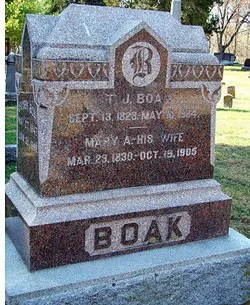
2. T.J. Boak
T. J. Boak came to Dallas County in May of 1859 after being in California for seven years. He farmed and was also a livestock dealer.
He came to Adel in 1871 and opened a general store on the SW corner of the square in the building that bears his name.
3. Benjamin Greene
Benjamin Greene was one of the first settlers in Adel. As a pioneer merchant, he sold goods opposite the NE corner of the square (location of the former jail). Adel named Greene street after him.
His residence was where Fareway Supermarket stands now. The house had a block house on its top to ward off Indian attacks. Fortunately, it was never used for its intended purpose.
He was a promoter of Adel's early railroad and gave two years of his time and donated several thousand dollars to it.
4. John Bly
John Bly was a longtime public servant in Adel. He held the offices of Sheriff, Justice of the Peace, Assessor, Town Clerk.
5. Albert Collins Hotchkiss
A. C. Hotchkiss grew up on a farm in New York State. Prior to turning 20, he enlisted in the Union during the Civil War. He arrived in Dallas County with his newlywed bride.
He farmed for seven years and then spent six years as Clerk of Courts.
In 1879, he purchase an interest in the Dallas County News and became editor a short time afterwards.
He also served two terms as postmaster in Adel.
He served two years in the statehouse as Senator from his district (comprised of Dallas, Guthrie, and Audubon)
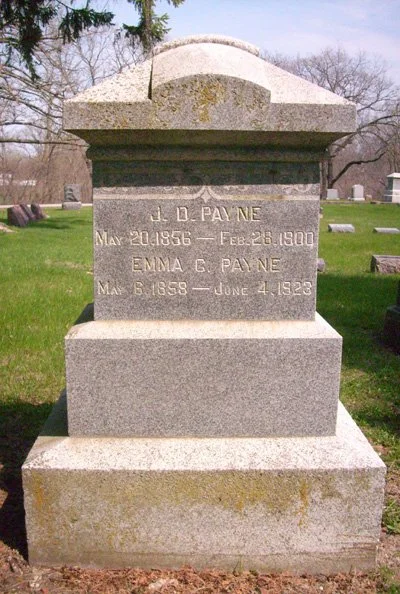
6. Joseph Dunn Payne
J.D. Payne was an early sheriff State Bank robbery. He opened fire on the robbers while they were still in the bank and led the posse after the fugitives to the South Raccoon River where they were apprehended.
He was killed by a train crossing railroad tracks while reading a newspaper in the south part of the country while on vacation.
7. Robert M. Keems
In 1883 Robert Keerns and his son-in-law A.C. Hubbard came to Adel from Illinois.
The two men established the first brick and tile factory in Adel which was located across Butler Creek (North 15" Street Curve- cemetery bridge crosses).
The plant was capable of putting out 20,000 bricks a day. They disposed of the plant in 1896.
8. Adelbert Carter Hubbard
A.C. Hubbard went into the furniture business after selling the tile factory. He then went into the grocery business on Main Street where the current H&R Block is located.
When he retired, he sold the business to Frank Clampitt but not the building. One night after the store was sold, it burned, and Mr. Hubbard rebuilt the building. After his death, Mr. Clampitt bought the building from the estate.
9. William Butler Kinnick
W.B. Kinnick's parents settled in Adel Township in 1854. His father first built a log cabin and then broke the wild prairie with ox teams. William had 16 siblings (3 died at birth). When William first started farming, he owned 40 acres, but he rented out the old family homestead and had charge of 160 acres. He kept buying land and eventually owned 1,245 acres and was an extensive buyer of cattle and hogs. In 1902, he was elected vice-president of the Adel State Bank. He and his wife had 8 children.
His son Nile Kinnick Sr. married Francis Ada Clarke (daughter of George &Arletta Clark) and lived in the yellow house on the corner of 12th & Rapids Streets.
His grandson Nile Kinnick, Jr. played football for Adel High School and went on to play for the University of Iowa and win the Heisman Trophy. Kinnick Stadium in Iowa City is named for Nile
Another son was Benjamin Greene Kinnick who died in WWII.
10. Sylvanus M. Leach
S.M. Leach organized the Adel State Bank in 1882 which occupied a building on the west side of the Courthouse Square. It was at that building where the infamous Adel bank robbery occurred. S.M. Leach was shot in the neck after refusing the robbers' demand to hand over the bank's money.
The bank later moved to the building that currently houses Fine Arts Photography.
The family lived in the white house on the corner of 11th & Court Streets (119 N. 11th).
11. Amos Dilley
Amos Dilley came to Iowa in 1857 and began teaching in Keokuk County. He enlisted in the First Regular Iowa Calvary in 1861 at the start of the Civil War.
During his first year of service, he was involved in pursuing Quantrill's guerrilla group of Southern sympathizers which were known as the Bushwhackers. Jesse and Frank James were infamous members of Quantrill's pro-slavery Bushwhackers.
The Quantrill gang raided Lawrence, KS, and 180 people were killed.
The anti-slavery supporters opposing the Bushwhackers were known as the Jay Hawkers. The University of Kansas is known as the Jay Hawks.
He also participated in the Battle of Spring Hill where 35 out of 75 rebels were killed and helped to capture Little Rock.
Amos Dilley started the Dallas County News in November, 1872. He was also a long-time county Superintendent of Schools and captain of the Adel Militia which was organized in 1878.
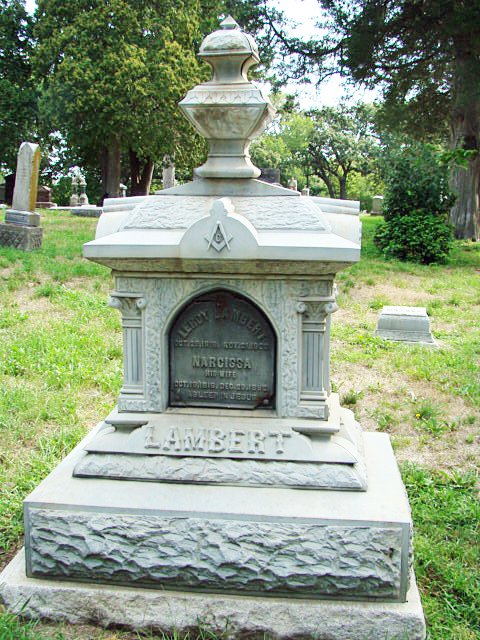
12. Leroy Lambert
Leroy Lambert moved to a 220 acre farm near Redfield in Dallas County in 1847.
In 1869, he moved into the old school house which was the first 2-story brick building built in Adel which is currently the Adel Historical Society and Museum in the 1100 block of Main Street. He lived most of his life in Adel.
He also opened the Dallas County Bank in Adel in 1869 and was in the banking industry for 17 years.
Leroy Lambert was active in starting up the Christian Church in Adel and purchased and donated their first organ.
The Lambert headstone is called "white bronze" but is actually constructed of Zinc which was a less expensive alternative by the Monumental Bronze Company which had a subsidiary in Des Moines, IA.
13. Solon T. Buckman
S.T. Buckman founded Buckman Hardware which was located where the Wells Fargo Bank used to be located. The store was in the family for 61 years.
14. Issac D. Marsh
I.D. Marsh came to Dallas County in the Spring of 1856. In 1857, he ran for sheriff of Dallas County. It was a tie vote so it was decided by drawing blank papers from a hat until one drew a paper with the word "Sheriff'' on it. He took office on January 1, 1858.
I.D. Marsh was a captain in the Civil War and was promoted to Major shortly before the end of the war. He marched with Sherman "to the sea".
After the war, he had a business making cement blocks which he traded for a farm on the South Raccoon River.
He moved back to Adel for retirement several years later.
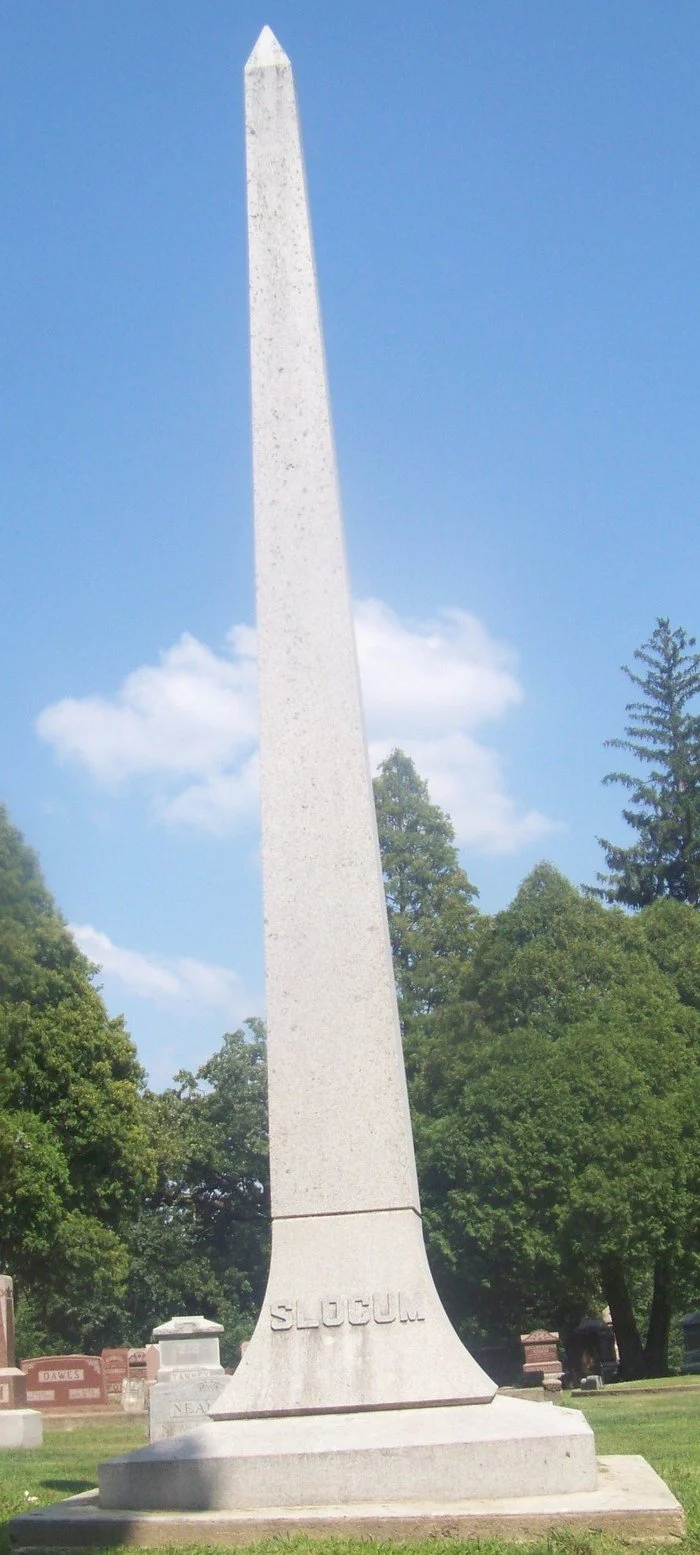
15. Joseph Slocum
Joseph Slocum was one of Dallas County's pioneer farmers.
Obelisks became popular gravestones due to the discovery of the Rosetta Stone in 1801 in Egypt. To ancient Egyptians, obelisks were petrified rays of sunlight where the sun god Ra lived. In graveyards, they symbolize ancient godliness and greatness.
16. John Barngrover
John Barngrover came to Iowa by covered wagon in 1854 and started farming. He owned 150 acres of land and was a Mexican War veteran and school director.
17. Harry V. Rickerson
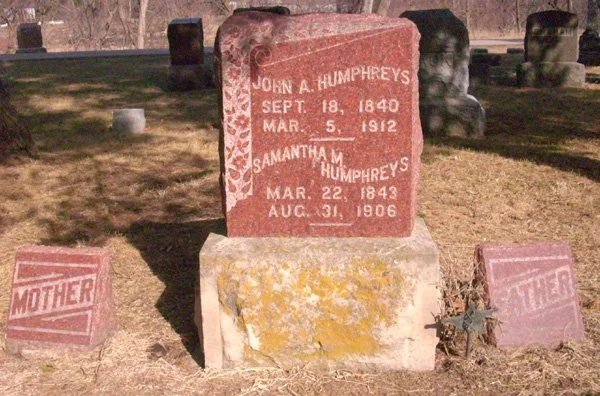
John Humphreys rented the northern part of this cemetery from the city for a cattle pasture.
Part of the deal was to remove all the brush.
He paid $12 a year to rent the land in 1894
John Humpreys
John Humphreys rented the northern part of this cemetery from the city for a cattle pasture.
Part of the deal was to remove allthe brush.
He paid$12 a year to rent the land in 1894
19. J.W. Russell
When J.W. Russell arrived in Adel in 1872, he was without capital and $150 in debt.
He clerked in a law firm and read law for a year before being placed in charge of a loan business. He was especially skilled in determining the value of land and its probable appreciation in price. The company he founded is currently Russell Abstract and Title and is run by Kent & Brett Glenn.
He was president of the Dallas County Saving Bank which evolved into the Brenton Bank and then Wells Fargo,
He served as vice-president of the first railway built through Adel. The company was organized in his office.
He was mayor of Adel in 1894, and the streets were paved with brick, sidewalks were laid, and a waterworks system installed under his administration. The stand pipe used to be at the corner of 15 & Main.
He resided in the large house at 1210 Grove.
20. Levi Diddy
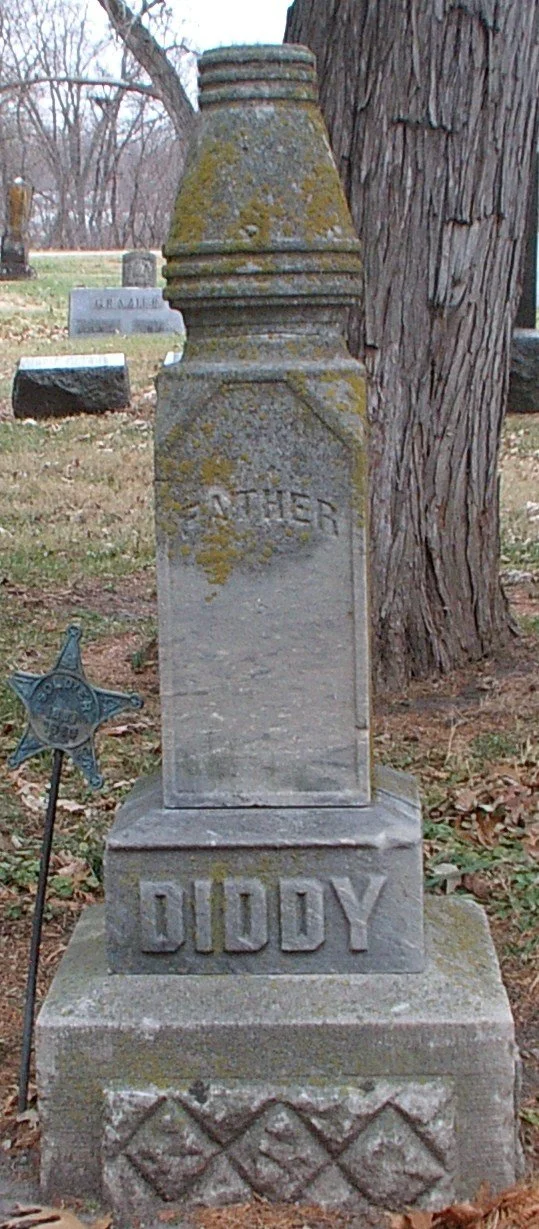
In 1850, Levi Diddy was determined to see the West. He started off on April 1 and visited Davenport, Iowa City, Des Moines, Warren County, Pella and Muscatine in Iowa, went through Illinois by way of Dixon and Joliet, and arrived back at home about the middle of June in good health and condition after completing the entire trip on foot.
He and his wife started out on September 6, 1852 to Adel in a prairie schooner and arrived on October 6, 1852.
He held the offices of Assessor, Coroner, Township School Director, Justice of the Peace, and was an Express Agent for eight years.
21. Samuel L. Ward
S.L. Ward grew up in Adel and was a member of the 3" Iowa Calvary. He took part in the latter part of the Battle of Pea Ridge, Arkansas, the latter part of the siege of Vicksburg, and went on the expedition against Memphis.
In 1865, he returned to Adel as a blacksmith until the fall of 1878 when he became the first engineer on the Adel railroad. After two years on the railroad, he built a machine shop and foundry in Adel. He was a very skilled blacksmith and mechanic- especially in the line of iron working.
There used to be a blacksmith located west of Adel TV (that portion of the building is no longer there).
S.L. Ward was Mayor of Adel in 1900.
22. Frank Middlekauf
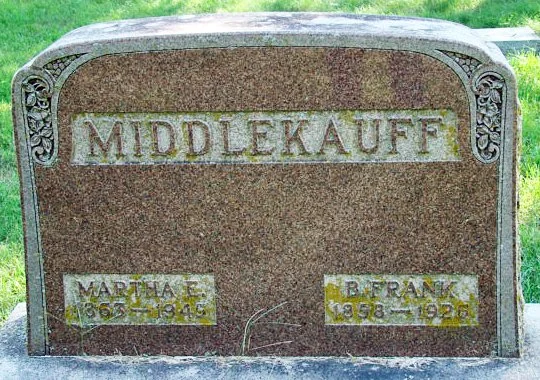
Frank Middlekauf was an early contractor in Adel and was responsible for building over 100 residences.
23. Irvan U. Ikenberry
Irvan Ikenberry had a photography studio in Adel and was the only photographer in this part of the county at the time.
He also had studios in Redfield, Panora, and Yale.
His photographs are instrumental in preserving the history of Adel.
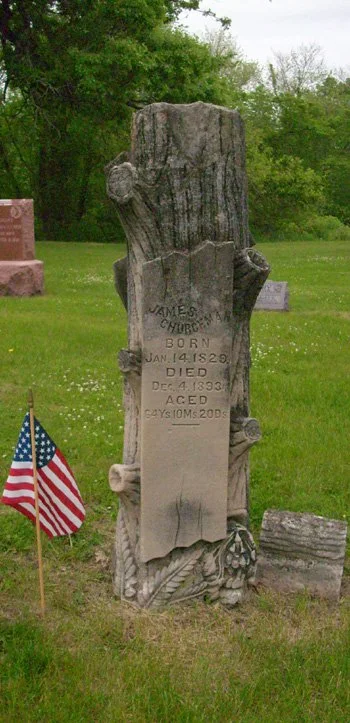
24. James Churchman
This unusual stone honors James Churchman. He was born in Tennessee and settled near DeSoto on a claim of 160 acres,
25. Thomas Ashton
Thomas Ashton was born in England and came to America in 1842. He moved to Adel in 1856.
Mr. Ashton was the first person in the livery stable business in town.
He served in the 39 infantry during the Civil War and served as postmaster for the regiment.
After he was mustered out, he returned and engaged in the livery business and farming. He was also superintendent of the railroad through Adel.
He resided in the big house located at 307 N. 15
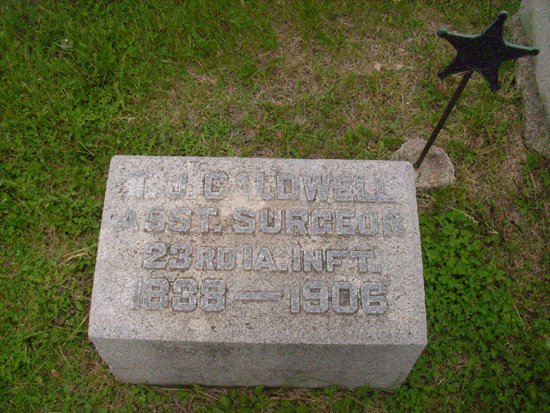
26. Dr. Timothy J. Caldwell
Dr. Timothy Caldwell was born in Indiana and spent his boyhood farming and acquiring an education
He came to Iowa in 1853 and settled near Redfield. He earned money as a farm laborer to finance a college education and graduated from medical college in Keokuk in 1861. The same year, he was appointed surgeon of the 23" Iowa infantry which he held until the close of the war providing valuable aid to the ill and wounded.
After the war, he returned to Adel and continued his medical practice.
He was president of the Adel State Bank and president of the railroad built through Adel. He was elected to the legislature for two terms. Probably no citizen contributed more largely of time, money, and influence than Dr. Caldwell.
He was Mayor of Adel in 1896
27. Coleman Noel
Cole Noel located in Adel in 1853 and was a resident for more than half a century.
He was a resident for less than three years when he was elected Clerk of Courts and served in that capacity for over 10 years.
He was elected a member of the 13 General Assembly which passed the appropriation for building the present state capital. While in the house, he carefully considered each question that came up for settlement and was connected with considerable construction legislation.
His first wife (Elizabeth) died at age 36 and is buried the Rodenbaugh cemetery.
He was elected Justice of the Peace in 1872 and held that position until his death. His decisions were strict, fair and impartial based upon the law and equity in the case.
Cole Noel passed away in 1906, and his funeral service was held in the Christian church. Businesses and public offices were closed out of respect
28. Alfred Neroin Ludington
A.N. Ludington saw many changes in America during his lifetime starting when the West was an untamed wilderness to when the United States was a modern industrialized country. He was born on July 16, 1836 and arrived in Dallas Country in 1852 with his parents.
Attracted by the Pikes Peak gold rush, he and 13 companions formed a gold-digging company. The company lasted until a point 25 miles west of Omaha. All but Mr. Ludington were scared off by stories of Indian attacks.
Not content to go back home without experience in the gold fields, he joined a party headed for Washington Territory. While on the plains, water was scarce and at times hard to get. On one such occasion, Mr Ludington noticed a small bunch of willows where he thought he could obtain water. He found no water but did find Indians among the willows. He thought the Indians wanted his scalp, but what drew their attention was his eight inch revolver in his belt. To keep them from taking the revolver, he made the Indians march in front of him until they reached the wagons- showing them by sign and motions what would happen if they refused. The Indians were armed with only bows and arrows.
He reached Fort Walla Walla, Washington and secured work driving government teams. After two weeks, he received $18 which allowed him to purchase passage on a boat going down the Columbia River to Portland, Oregon where he arrived September, 1859.
In January, he had the opportunity to work his passage on a steamship bound for San Francisco.
After 2-3 days there, he got a chance to work his passage on a boat to Sacramento and then to Hangtown (now Marysville, California) where he worked in the mines until March, 1860.
He then obtained work around Oakland at $25 a month and remained there until February, 1861.
He then took passage on a steamship bound for New York for $200. He took the train from New York to Iowa City and arrived with $50. He then traveled by foot to Adel which took three days.
In April, 1861, he rented land from Benjamin Greene which he farmed that summer. He sold his crop to Mr. Greene for 5 cents per bushel and joined the 39" Iowa Infantry on August 9, 1862. He marched with Sherman to the sea and was discharged on June 5, 1861
After returning from the Civil War, he purchased 40 acres in Colfax Township and later added a tract of 80 acres. He engaged in farming for over 20 years but retired to Adel in 1887.
He also served 2 years as deputy under Sheriff Payne.
He died on June 8, 1932 at the age of 95.
29. Luna Meshach Macy
L.M. Macy was an early millwright in Dallas County.
He was born six miles south of Redfield. After he married, he took charge of the Van Meter mill near DeSoto. He stayed there until 1891 when he purchased an interest in the Adel mill alongside the dam.
In 1900, he put in an electric light plant in connection with the mill. The same machinery that ground the grain during the day lit up the city at night.
In 1902, he bought out the other shareholder interests and took his sons into the business and increased the light plant capacity. The mill and light plant burned in August 1914. A fireproof light plant was rebuilt that same year without a mill.
His son Verne Macy drowned in the river in 1909 when the boat he was in struck a snag and capsized.
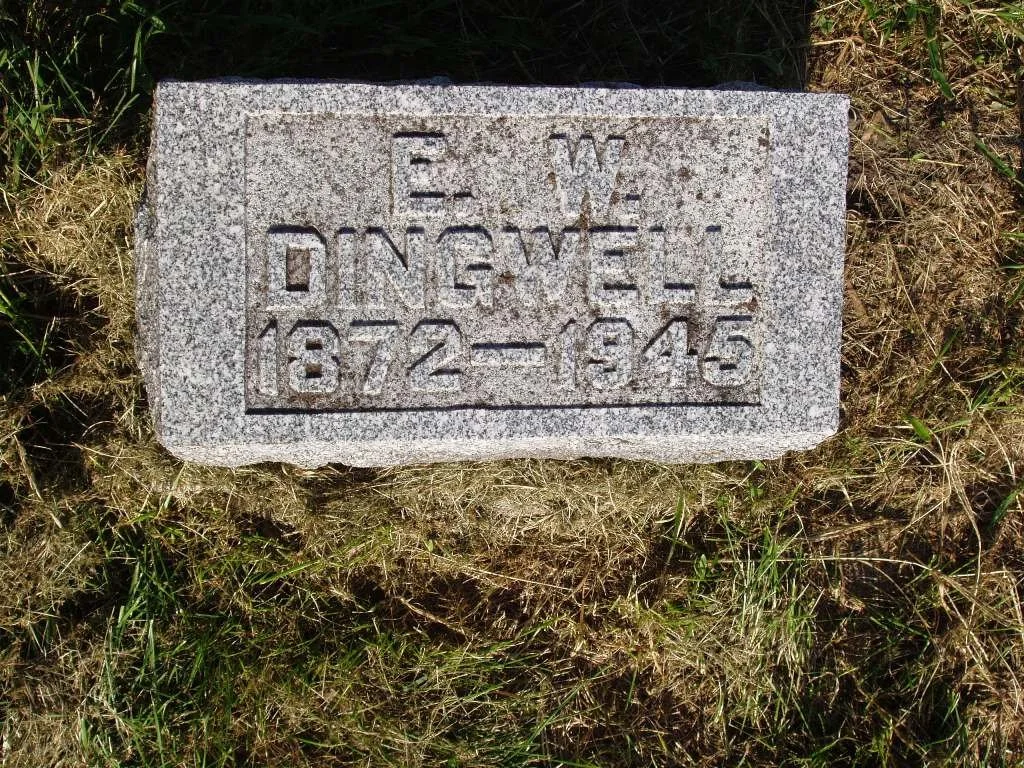
30. Ernest Wilmore Dingwell
E.W. Dingwell was born in Prince Edward Island, Canada in 1872. He served in the Spanish-American war. He was appointed Fifth Judicial Judge in 1904. He died July 7, 1945.
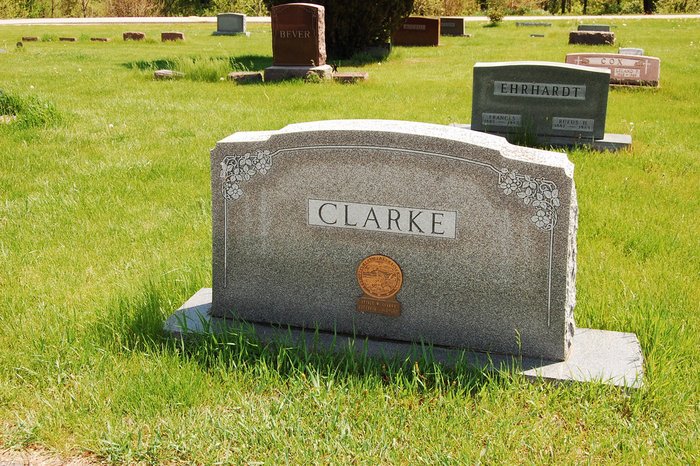
31. George Washington Clarke
George W. Clarke opened up a law practice in Adel in 1878. He served as a Washington Clarke justice of the peace for a time, but soon formed a partnership with John B. White.
He became active in Republican politics and served four terms as the Dallas County representative and was Speaker of the House during two of his terms.
He served as Lt Governor from 1908 to 1912 and was a candidate for Governor in 1912. The Republican vote split that year, and George Clarke won by a narrow margin of 1699 votes. In 1914 he had a hard fight against bitter opposition because of his support of the capital grounds extension program which called for acquiring ground adjacent to the statehouse to eliminate the shanties and other disreputable buildings in the area. He was elected after a hard campaign in which he spoke in every county seat in Iowa except one. He was a tireless, forceful, and eloquent speaker with a resounding and vibrant voice and a forthright and convincing manner.
After his four years as governor, he served as dean of the Drake Law School and then returned to Adel to enjoy his retirement.
During the Adel bank robbery, Mr. Clarke had a law office above the Adel State bank. He went downstairs to see what the commotion was. When he entered the front door, Orlando Poe Wilkins (one of the bank robbers) whirled around and aimed the shotgun at his chest and pulled the trigger. The gun misfired and the shell failed to go off. The bandit worked the gun lever to load another shell from the magazine into the barrel which allowed Mr. Clarke to exit the bank and return upstairs.
He resided at 207 N. 15th Street.
32. John B. White
John Bushrod White came to Adel in 1873 and began teaching and serving as the Principal of Adel High School.
Upon graduating from law school in Oskaloosa, he practiced law in Dallas County. He entered into a partnership with Governor George Clarke in 1882.
John White (Mary) and George Clarke (Arletta) both married daughters of Benjamin Greene.
Mr. White was fluent in four languages besides English- Latin, Greek, French, and Spanish.
He was Mayor of Adel in 1900.
33. 1895 Adel State Bank Robbery
On March 6, 1895 at 8:30 A.M.., Orlando Poe Wilkins and his cousin C.W. Crawford of Patterson of Madison County entered the Adel State Bank which was located on the West side of the Courthouse Square.
One man produced a sack and said he wished to make a deposit. The other man advanced with a Winchester shotgun in his hand and ordered S.M. Leach, the cashier, to "fill that sack!".
The order was refused and S.M. Leach grabbed bundles of money and started to carry them to the vault. One charge of buckshot hit him in the neck and another in the shoulder.
C.D. Bailey who was there to make a deposit grappled with the bearer of the gun and was shot in the neck after being knocked down.
The robbers hastily scooped up a sack of silver containing about $260 and started their getaway.
The shots aroused people around the Courthouse Square. Sheriff Joe Payne came out of a nearby store and opened fire on the robbers.
The robbers ran to their wagon and team which was hitched to a post on the NW comer of the Courthouse Square and started their getaway heading west.
The citizens of Adel armed themselves and opened fire on the fleeing bandits. J.M. Byers was shot in the hand, Postmaster Robert S. Barr was wounded in the head and wrist, Cecil Decker was wounded in the head and arm, and J.L. Simeoke was struck in the neck.
Within minutes, a posse was on the trail of the robbers. Horses from the livery stables were pressed into service, individuals saddled their own animals, and others followed in buggies and wagons. Dan Snyder, Charley Warford, and Tom Reynolds were the first out and kept the fugitives in sight.
The robbers were apparently headed for the rough timberland of the South Raccoon River and were almost there when a shot by Charles Kissick injured one of their horses, and the men were compelled to abandon their rig.
Orlando Wilkins took refuge in a barn, and C.W. Crawford hid in the timber.
C.W. Crawford came out of the trees and surrendered when the posse began to close in.
Hundreds of shots were fired into the barn, but Orlando Wilkins refused to surrender. His partner was compelled to set fire to the building.
The heat soon drove Orlando Wilkins outside where he was ordered to surrender. He refused and was killed instantly when his body was riddled with bullets.
C.W. Crawford was brought back to town along with the stolen money by the Sheriff where he was identified as a resident of Patterson in Madison County. Officials in charge of the prisoner prevented his lynching. He served 13 years in prison for his part in the robbery.
The body of Orlando Poe Wilkins was brought back to town in the Reynolds and Utz meat wagon and put on display, upright in the coffin, in front of the bank building. He is buried on the hill in Potter’s Corner.
Wilkins was a relative of the captured Crawford and had just completed a term in the Minnesota Penitentiary prior to his return to his home in Madison County. He had teamed up with Crawford and planned to rob banks in Summerset, Indianola, and Cummings but found no opportunity in those locations prior to coming to Adel.
Post-bank robbery, the Adel State Bank relocated to 901 Main (currently Fine Arts Photography). The bank went into receivership in 1935.