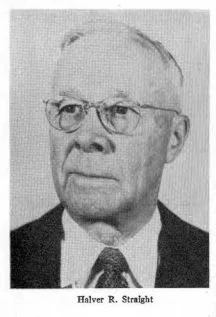
Halver R. Straight
1882-1956
Brick Manufacturing, Soybean Plant, Straight Engineering, Mineral and Fossil Collector
Halver R. Straight, better known as H.R. Straight, was born in El Paso, Illinois, on August 24, 1882. H.R. viewed school as important and held a perfect attendance record during grade school. H.R. originally enrolled at Grinnell College and later changed to the University of Illinois where he majored in mechanical engineering. He was a member of the university’s mechanical engineering club and later joined the engineering honor society Sigma Xi. During his time as an undergrad, he also played clarinet in the military band and was a member of both the Hawkeye theatrical and Scandinavian ski clubs. He met his future wife Ethel Hoge at the University and later married her in 1909. They had a son named Lee and two daughters named Betty and Dorothy.
H.R. Straight came to Adel in 1907 and, along with his brother Merton, purchased a company called Dallas County Brick & Tile. It was then renamed Adel Clay Products and H.R. Straight became president and general manager. One of the earliest things H.R. Straight did while operating in Adel was promote the building of brick homes for employees of the brick operating business. Some of these he sold to company employees for easy terms. 23 homes were still in company ownership in 1958 when the plant was acquired by Sioux City Brick and Tile company.
In 1926 H.R. and Merton sold their plant at Adel to United Clay Products Company. Having retained the name Adel Clay Products Company, they moved to Redfield where they built another brick plant and continued in business. Merton, afterwards, ran this operation until the facility was purchased by the Goodwin family after H.R. Straight passed away. H.R. also built and operated a large soybean plant at Redfield, later owned by Cargill. During these busy years he also set up the Straight Engineering plant in Adel.
H.R. Straight’s greatest pleasure in life was keeping busy at some task which would benefit the community and the people around him. When one project was successfully launched and put into capable hands, he would start another. He was a man ahead of his time in many ways. Below is are two examples of the many innovative projects he completed in his lifetime.
H.R. Straight designed the silos for the bean plant over Redfield and had them built in two weeks. They were quite the engineering feat and possibly one of the first slip formed silos in Iowa.
He also designed a high school gym for Yale High School in Iowa that was added in 2019 to the National Register of Historic Places for its uniquely round shape and well-preserved construction. Completed in 1932, it was the first building of its kind in the state of Iowa. The gym contains a basketball court that measures 65’ by 35’, with rounded corners for which the walls were considered out of bounds during play. The intimate space created a unique ball-playing experience for students—the National Federation of High School Associations defines a high school basketball court as 84 feet long and 50 feet wide. Basketball games were held in the gym from its completion until 1961.
His main hobby was collecting minerals, gems, fossils and Indian artifacts. When the first national convention of the American Federation of Mineralogical Societies was held in Denver, Colorado, in 1948, Halver filled his station wagon with other collectors and went to Denver. There after he attended, if not all, nearly all of the conventions from one end of the country to the other. H.R. Straight willed his extensive rock collection to the Central Iowa Minerological society which is on permanent loan to Drake University. Part of it is on display there.
In the last few years he began to specialize in petrified woods and soon amassed a large collection of many varieties and exhibited them across the country. In 1956, H.R. was instrumental in bringing to Iowa Dr. C. W. Arnold of the University of Michigan, a leading Paleobotanist, to identify and study the huge fossils uncovered in the strip mine on the John M. Barnett farm near Knoxville, Iowa. Also in this period he was interested in the Paul Hawbaker find of pits along the river northwest of Adel. Here was evidence of ancient Indian life, a barbecue pit, bones and other items appearing to be, perhaps, 1,500 years old, and H.R. assisted in getting the carbon dating of the ash content of the pits and in other ways helped Mr. Hawbaker in the exploration and development work.
H.R. Straight was very active in organizations related to his businesses as well as local service organizations. He was past chair man and director of the National Structural Clay Products Association and director of the Iowa Division. He was a member of the American Ceramics Society and of the lubrication committee, the British Clay Workers Association and of many other organizations dealing with the clay industry. Later in life, Straight served as president of the Midwest Federation of Mineralogical & Geological Societies.
Locally he served terms as president for Adel’s Chamber of Commerce, was a charter member of the Adel Rotary Club, a member of the Scottish Rite and Za-Ga-Zig Temple of the Shrine, an elder and teacher in the Christian Church, and leader in many other activities.
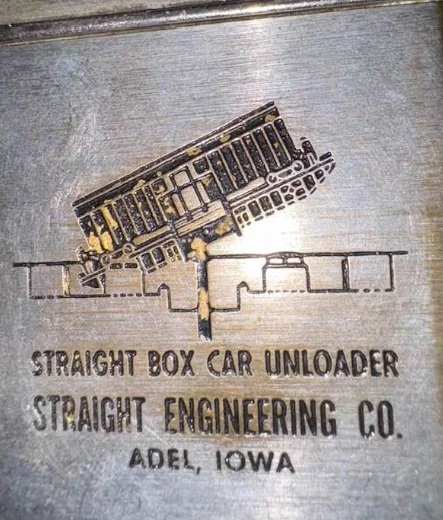
HR straight died in 1956. Straight Engineering Co. was continued under direction of his son Lee, and Lyle A Hanson. At the time of his death, H.R. held 87 patents, many pertaining to brick manufacturing. For example, he invented and manufactured pugmill knives and other devices used in the making of brick and tile. He also purchased patent rights on a boxcar unloader and his Straight Engineering Company of Adel manufactured this equipment.
Scholars selected his 1907 college thesis, Modern Methods of Brick and Tile Manufacture, as being culturally important and is part of the knowledge base of civilization as we know it. As such, it was turned into a book that can be preserved, reproduced, and made generally available to the public. It is available in multiple places for free online.
Sources: Adel Stories and In Memoriam, Proceedings of the Iowa Academy of Science, 1957 and Alum's prolific career memorialized through diverse contributions, The Grainger College of Engineering, 03/08/22