
George W. Clarke
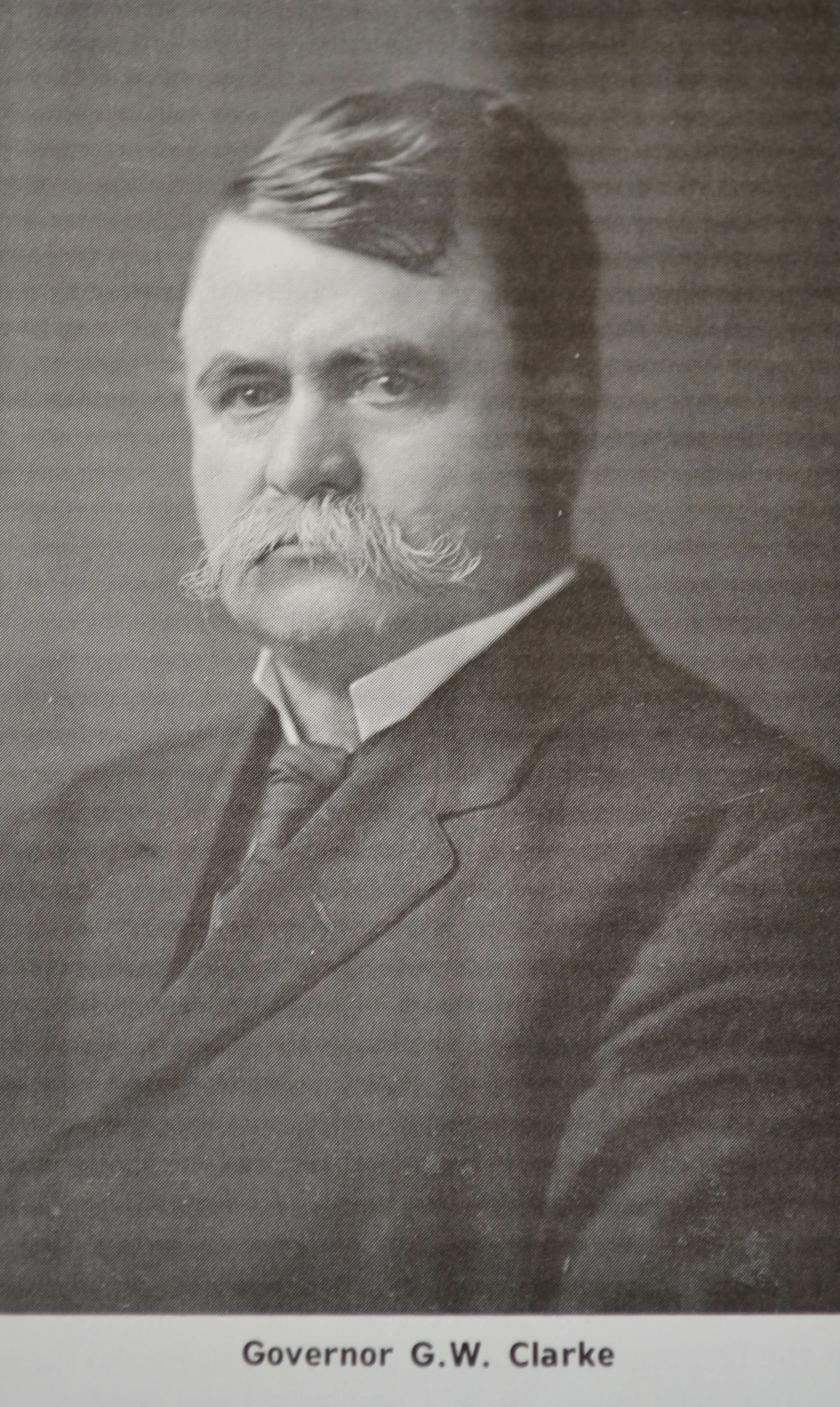
Key Facts
Lived from 1852 to 1936
Lawyer
Shot at during the infamous Adel State Bank robbery in 1895 but survived as the gun clicked but did not fire
Justice of the Peace and Legislator
Governor of Iowa from 1913 to 1917
Dean of Drake Law School
Grandfather of Nile Kinnick Junior
Biography
George W. Clarke was born in 1852 in Shelby County, Indiana, and in 1856 moved with his family to a farm in Davis County, Iowa, near the little town of Drakesville. His passing occurred in 1936 in Adel, Iowa. His lifetime of 84 years saw this country change from a predominantly rural and agricultural one to the leading industrial country of the world. In his later years he reminisced about the days when he saw flights of passenger pigeons (now extinct) so vast that they actually darkened the sky and took hours to pass a given point. He recalled shooting prairie chickens with a muzzle loading rifle as they perched on the rail fences and the haystacks. He remembered Confederate cavalry raiding in Davis County. He lived beyond the date of Lindbergh's historic solo flight to Paris.
After finishing high school, he taught country school for a short while in Davis County, and then attended Oskaloosa College at Oskaloosa, Iowa, (now Drake University at Des Moines, Iowa), where he met Arletta Greene of Adel, daughter of Benjamin and Permelia Greene, pioneer settlers in Adel. After graduation from Oskaloosa College he attended the University of Iowa Law School in 1878 which at that time consisted of a one year's course of study. The university was located entirely on the east side of the river, the west side was chiefly timberland.
Upon graduation from the law school he came to Adel, and he and Arletta Greene were married in 1878. They had four children: Fred G. Clarke, Charles F. Clarke, Portia Clarke (who married Wilbur VanMeter) and Frances Clarke (who married Nile Kinnick). Frances and Nile’s two oldest sons Nile and Ben grew up in Adel and were active in sports and other school activities. Nile Kinnick Jr. went on to the University of Iowa where his high intelligence, perseverance and determination won him fame on the gridiron and recognition in the classroom. Nile and Ben gave their lives in the service of their Country in World War II.
When George W. Clarke opened his law office in Adel in 1878, he wondered who in the world would ever come to him for legal assistance. For a time, he was a Justice of the Peace, but soon formed a partnership with John B. White to form the firm of White and Clarke, with son Charles succeeding him when he became Governor. George narrowly escaped being shot at the time of the robbery of the Adel State Bank in 1895. At that time the bank was located across the street west of the courthouse and the White and Clarke office was above the bank. In regard to this incident Charles F. Clarke, in his biography of his father, says:
“White and Clarke, attorneys, occupied an office over the bank and my father was the junior member of the firm. He heard the shots in the bank below and rushed down to see what was going on. He threw open the bank door and started in and the man with the shotgun whirled and pointed it point blank at him and pulled the trigger. The gun misfired. The shell failed to go off and the bandit worked the lever and threw the shell out on the floor and another from the magazine into the barrel. By the time he was ready to shoot again father had gone out the door and into the street again."
Governor Clarke became active in Republican politics and served four terms as the representative of Dallas County in the legislature during two of which he was Speaker of the House. He served as Lieutenant Governor from 1908 to 1912 and in 1912 became a candidate for Governor. 1912 was the year of the Bull Moose Party and Teddy Roosevelt's candidacy for the presidency. This split the Republican vote and George won by the narrow margin of 1699 votes. In 1914 he had a hard fight against bitter opposition because of his support of the capitol extension program which called for acquiring ground adjacent to the statehouse to eliminate the shanties and other disreputable buildings in the area. He was elected after the hardest of a campaign. He was an effective campaigner; tireless, a forceful and eloquent speaker with a resounding vibrant voice and a forthright and convincing manner.
After his four years as governor, he served as Dean of the Drake Law School and practiced law in the Des Moines for a short time before returning to Adel where he and his wife received great enjoyment from being host to their children and grandchildren and their many friends who enjoyed sports and games on their spacious lawn and tennis court.
Source: Adel Quisquicentennial Book, 1847-1972